Print Quality Inspection Appliance suits narrow web tasks.
Share:
Press Release Summary:
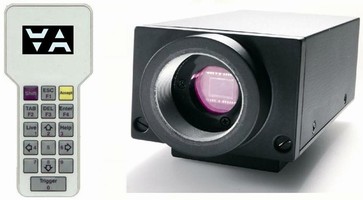
Measuring 120 x 50 x 35 mm, PQEye(TM) checks position, correctness, and quality of text and graphics machine-printed on discrete parts moving at up to 300 m/min. Smart camera-based system can be configured with resolutions to 1,280 x 1,024 pixels and uses Texas Instruments' DSPs. Included inspection software features automated training procedure and lets system detect defects down to a few pixels while clearly differentiating between normal print variations and unacceptable print flaws.
Original Press Release:
The PQEye(TM) Print Quality Inspection Appliance Now Packs More Power
CAMBRIDGE, Mass- The Value Engineering Alliance, a leading provider of machine vision products, announces performance enhancements to its standalone print quality inspection appliance, The PQEye(TM), that result from using newer generation hardware as the product's implementation platform.
The PQEye is a compact (120 x 50 x 35 mm, without a lens), smart camera-based instrument that has been used to address narrow web print inspection tasks and check the position, correctness and quality of text and graphics machine-printed on discrete parts.
Formerly available at a maximum resolution of 782(H) x 582(V) pixels, systems can now be configured with resolutions of up to 1280(H) x 1024(V) pixels to provide reliable detection of defects smaller than those that could be identified by earlier models. And this ability to resolve more subtle defects does not necessarily have to come at the expense of speed since it is now possible for PQEyes to be powered by Texas Instruments Digital Signal Processors that operate at 1GHz and supply computational power of 8000 MIPS.
The PQEye's inspection software features an automated training procedure during which all typical print variations are taken into account. This results in the setting of sensitivity levels that enable the system to reliably detect defects only a few pixels in size on media moving at up to 300 meters/minute, while still clearly differentiating between normal print variations and unacceptable print flaws. The system's setup, training and test procedures are all done using its multifunction keypad and a graphical user interface that displays on a standard SVGA or SXGA monitor.
Equally effective inspecting the results of offset, flexographic, thermal transfer, laser, and other common printing processes, the PQEye has been used to address many applications which were previously the domain of PC-based vision systems and proprietary "big-iron" boxes.
Typical high-end applications include the inspection of pharmaceutical product, food and consumer goods labels as well as integration into rewinders, cutting and slitting machines and high-speed bottle cap printing machines. Typical low-end applications include the inspection of pad or laser printed information on electronic components, keyboards, mobile phone and other kinds of keypads, printing and decorations on bottle caps, screenprinting on porcelain and glassware, lasermarked indicator/operator symbols on automobile dashboard panels, pharmaceutical labels and cartons moving at slow speeds and printing on medical equipment and dosing devices.
User-friendly, easy to integrate, and economical, PQEyes provide very appealing levels of price/performance and enable companies to routinely achieve rapid returns on their investments.
For additional information, visit http//www.The-V-E-A.com, email MarcelVEA@aol.com or call (617) 492-1252.
About The Value Engineering Alliance
Established in July of 1987, THE VALUE ENGINEERING ALLIANCE specializes in the conceptualization, development, marketing, selling, and implementation of machine vision solutions that lower the overall costs of laboratory and industrial manufacturing operations (analysis, assembly, inspection, test, control, identification, etc.) while achieving equivalent or enhanced levels of system/process performance and reliability.
Renowned as the supplier of application-specific vision software libraries used by several of the vision industry's premier players to enhance their existing offerings or expand into new application arenas, The VEA has been equally successful as a supplier of vision software and systems used in numerous industries by OEMs, system developers/integrators and automation engineers inside end user organizations. Based in Cambridge, Massachusetts (USA), the VEA operates worldwide via its extensive network of allied organizations and individuals. For additional information about the VEA's activities and areas of expertise, visit www.The-V-E-A.com.