Power Transmission Belt prevents static electricity buildup.
Press Release Summary:
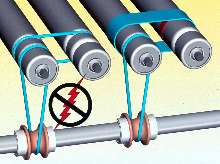
Static Dissipative Belt is made from Cyclothane-SD thermoplastic urethane. O-ring belt offers volume resistivity of 2 x 10⁹ ohms-cm, surface resistivity of 2 x 10⁹ ohms/sq, and static decay rate of less than 0.01 seconds. Classified as static dissipative, belt is suitable for live-roller conveyors or light-duty power transmission applications. Belt is available in 2 formulations: Cyclothane-85ASD and Cyclothane-90ASD.
Original Press Release:
New Static Dissipative Urethane Belts Prevent Buildup of Static Electricity
Cyclothane-SD offers static decay rates 10-100 times better than competing products at comparable price
Hilliard, Ohio - A new power transmission belt from Dura-Belt prevents buildup of harmful static electric charges caused by friction between belting and pulleys or rollers. Dura-Belt's Static Dissipative Belt is made from Cyclothane-SD, a thermoplastic urethane specially formulated to minimize harmful static electric charge buildup on conveyors and other machinery.
Cyclothane-SD belts offer the lowest resistivity of any solid urethane O-ring belt (volume resistivity 2 x 10⁹ ohms-cm; surface resistivity 2 x 10⁹ ohms/sq; static decay rate <0.01 seconds). This low resistivity is classified as "static dissipative" because it eliminates static faster than "anti-static" materials. Cyclothane-SD has resistivity and static decay rates that are ten to 100 times better than those of competing anti-static urethanes, yet its price is comparable.
Because urethane tends to insulate rather than conduct, urethane belts have traditionally been unsuitable for static sensitive applications such as electronic manufacturing, paper handling, and clean room environments. Urethane's conductivity can be increased by adding conductive fillers like carbon and metal particles, but they degrade elasticity and weldability. Surprisingly, they often fail to increase conductivity because when urethane belting stretches, the conductive particles move apart, causing short circuits. New conductive urethanes are an improvement, but their resistivity and static decay rates are still too high for most static-sensitive applications. Cyclothane-SD is a second generation conductive urethane with resistivity and static decay rates that are low enough for many more applications.
Cyclothane-SD contains an elastic conductive thermoplastic that is chemically combined with urethane molecules, so its static dissipative properties will not decrease with age or stretching. It is also more flexible and reliable than carbon or metal filled urethanes and it splices more easily, so that welds are easier to make and much stronger.
Cyclothane-SD belts are used on live-roller conveyors or in light duty power transmission applications where static buildup must be minimized. Applications include electronics manufacturing, where static charges could damage sensitive circuit board components; drug and optics manufacturers; paper handling systems, such as post offices; and clean room environments, where static electricity can cause particles to cling to surfaces, rather than be flushed out through the ventilation system.
Dura-Belt Cyclothane-SD Static Dissipative belts are available in two formulations. Free samples are available.
Cyclothane-85ASD: 85A durometer, gray thermoplastic urethane, highly abrasion resistant, temperature range 20° to 110° F. Recommended stretch 10%.
Cyclothane-90ASD: 90A durometer, light blue thermoplastic urethane, mold and UV resistant, temperature range -10° to 110° F. Recommended stretch 9%.
Both products offer relatively low resistivity:

o Volume resistivity 2 x 10⁹ ohms-cm   Test method: ASTM D-257

o Surface resistivity 2 x 10⁹ ohms/sq  Test method: ASTM D-257

o Static decay rate < 0.01 seconds     Test method: 12% R.H. FTMC-101C

   (+5000V 50V)
Dura-Belt manufactures a wide variety of standard and custom high-quality urethane belting and associated products, including endless O-rings, twisted connectable belts, V-belts, flat belts, spools, idler pulleys, belt installers, and splicing accessories.
For more information contact Dura-Belt, Inc., 2909 Scioto Darby Executive Ct., Hilliard, Ohio, 43026. Tel: 1-800-770-2358 or (614) 777-0295. FAX: (614) 777-9448. www.durabelt.com.