CAM Solution optimizes speed through hardware utilization.
Share:
Press Release Summary:
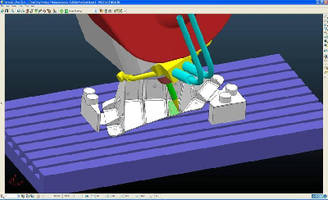
PowerMILL CAM v10 incorporates background-processing and multi-threading technologies, using full power of hardware to reduce calculation times and increase output. Optimized memory usage also lends to productivity when programming large and complex parts, while ordering capabilities accelerate cycle times on machine tool. Delivering accelerated toolpath generation on multi-processor computers, solution lets users prepare data in foreground while calculating toolpaths in background.
Original Press Release:
Delcam Launches Fastest-Ever CAM
Delcam has launched version 10 of its award-winning PowerMILL CAM system, which offers the fastest-ever toolpath generation on multi-processor computers, giving greatly increased user productivity. The new release incorporates the latest background-processing and multi-threading technologies and so uses the full power of recent hardware developments to reduce calculation times and increase output dramatically.
Other enhancements to further increase productivity include reduced memory usage when programming the largest and most complex parts, and improved ordering to give faster cycle times on the machine tool.
Full details on the new version can be found on the PowerMILL 10 release centre - www.powermill.com/rc10. This also includes a white paper on the use of multi-threading and background processing, details on recommended hardware for PowerMILL 10, a return-on-investment calculator showing how quickly an investment in the software can be recovered, and a number of customer video testimonials.
The main benefit of PowerMILL 10 is that users can prepare data in the foreground while calculating toolpaths in the background. This eliminates the need for the user to wait for each calculation to be completed before he can start preparing the next operation. For example, it is no longer necessary to wait for a complete roughing path to be produced before work starts on programming the rest-roughing operation. Similarly, the user can be setting the parameters needed to machine one area of a part, while toolpaths are being calculated in the background for machining a second area with a different strategy.
Productivity is also increased because the computer can continue with a series of calculations during the user's breaks or even overnight. Calculations can be queued by the operator and the software will automatically start the next operation as soon as each toolpath is generated. This approach can be used with single core equipment but the benefits are even greater with computers having two or more cores.
The new multi-threading capabilities allow individual calculations to be divided between the cores in a multi-core machine. This improves calculation times significantly so increasing user productivity, reducing any down-time where machine tools are waiting for NC data and minimising lead times.
The extent of the savings will depend on the size and complexity of the part being machined and on the programming strategies being used. Tests at Delcam indicate that a dual core computer will perform raster machining calculations in around 55% of the time taken by a single core machine. A quad core machine will complete the calculation in around 35% of the time and an eight core machine in around 25% of the time.
For further information on Delcam's PowerMILL CAM software, please contact: -
Peter Dickin, Marketing Manager
Direct phone: 44 (0)121 683 1081
e-mail: marketing@delcam.com
Delcam plc,
Small Heath Business Park,
Birmingham, B10 0HJ, UK
www.delcam.com